
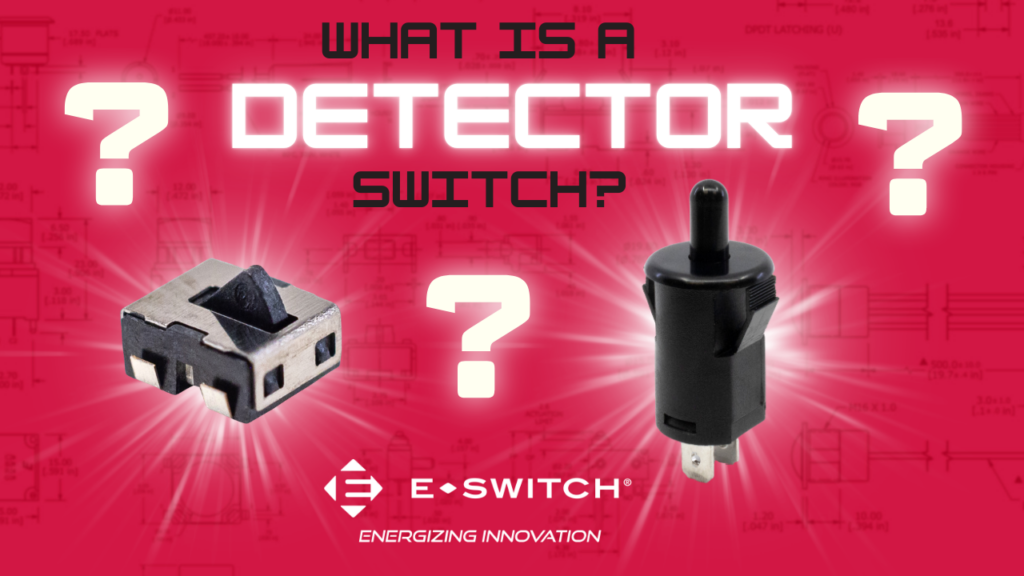
What are Detector Switches?
A detector switch typically refers to a switch that’s used to detect the presence/absence of an object or to sense a particular condition. Electromechanical detector switches respond to an external stimulus on the actuator to change the state of the contacts and open or close the electrical circuit.
These electromechanical switch types are commonly employed in various applications where the detection of a specific state or object is necessary, such as industrial automation, security systems and electronic devices.
How do They Work?
The basic working principle of a detector switch involves the mechanical movement of components inside the switch in response to an external stimulus. They detect changes in mechanical state and output a clear electrical signal.
There are different types of detector switches, and their operation may vary based on the specific design and application. Here are a few common types:
- Limit Switches: These are often used to detect the presence or position of an object. Limit switches consist of an actuator that’s mechanically engaged by the movement of an object, causing the switch contacts to change state. They’re commonly used in industrial applications to control machinery and equipment.
- Proximity Switches: These are used in various technologies, such as inductive, capacitive or photoelectric sensing, to detect the presence or absence of an object without direct physical contact. These switches are often used in applications where non-contact sensing is preferred or in environments where physical contact may not be practical.
- Pressure Switches: Pressure switches detect changes in pressure and are commonly used in fluid systems. When the pressure crosses a certain threshold, the switch activates or deactivates, signaling the change in pressure.
- Motion Sensors: These detectors use various technologies, including infrared, ultrasonic and microwave, to sense motion. Motion sensor switches are often used in lighting control systems and security applications.
The specific operation of a detector switch depends on its type and technology. For example, in a limit switch, the movement of an actuator might physically open or close electrical contacts. In a proximity switch, changes in the field (inductive, capacitive or optical) are used to trigger the switch without direct contact.
Pros & Cons
Pros
Versatility: There are different types of detector designs for specific applications. This versatility allows for a wide range of uses across different industries. E-Switch detectors are available for surface mount (SMT), through hole (THT) and panel mount applications.
Automation: They play a crucial role in automation by enabling the automatic control of processes and machinery based on the detection of specific conditions or objects. This contributes to increased efficiency and reduced human intervention.
Long Lifespan: Many detector switches can have a long operational lifespan. Solid-state detectors can offer extended reliability without the wear and tear associated with moving parts.
Precision: Some switches, especially those using advanced sensing technologies like laser or infrared, can provide precise and accurate detection, making them suitable for applications where high precision is essential.
Cons
Complexity: Some types of switches, such as those employing complex electronic sensing technologies, can be more intricate and challenging to understand, troubleshoot or maintain compared to simpler electromechanical switches.
Sensitivity to Environmental Conditions: Certain detector switches can be sensitive to environmental conditions such as dust, humidity or temperature variations.
Limited Range: Certain proximity switches may have limitations in the distance over which they can reliably detect objects. The range of detection is a crucial factor to consider depending on the application requirements.
Common Uses
- Position Detection in Machinery: CNC machines, robotics, packaging equipment and conveyor systems
- Door, Lid and Panel Detection: Interlocks in appliances, industrial cabinets and printers
- Consumer Electronics: Detecting battery compartment closure; signal provided for actuation
- Safety Confirmation: Used to prevent motors, heaters and actuators from engaging if conditions aren’t met
E-Switch Detector Switch Offerings
E-Switch has the largest selection of detector switches on the market with the following lineup:
- 900 Series: Subminiature, SMT right angle
- MR1000 Series: Recessed magnetic, reed switch
- PP1 Series: Push-pull, UL listed
- PP2 Series: Push-pull, UL listed
- TD1146 Series: SMT, ultra-miniature
- TD1150 Series: THT, IP65 sealed
- TD1250 Series: THT or panel mount, IP67 sealed
- TD4700 Series: SMT, ultra-miniature
- TD1260: SMT, angled toggle actuator
- TD1350: Door interlock, pushbutton detector, UL listed
