
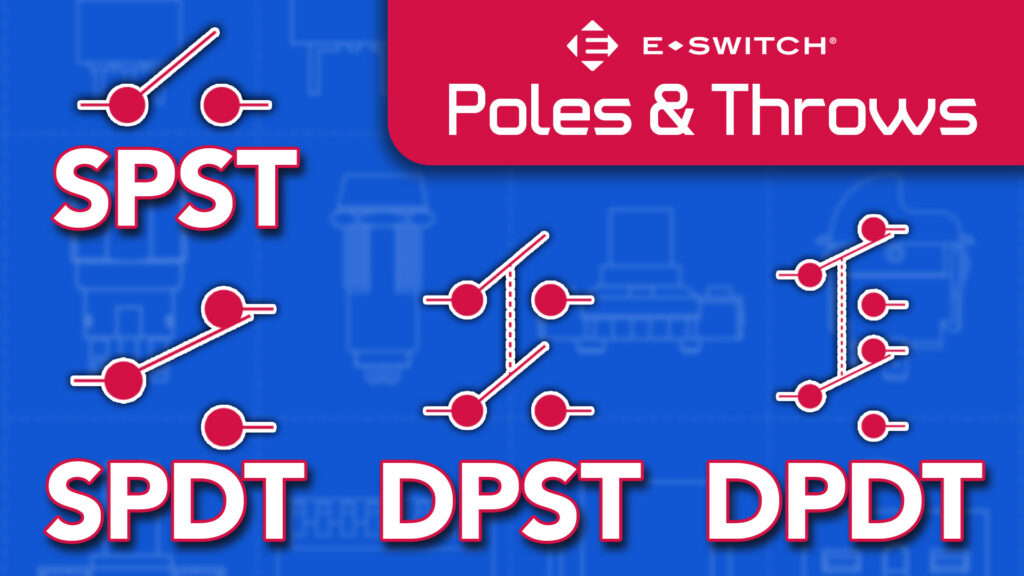
When selecting a switch for your application, you’ll need to consider the electrical circuit function. Is it SPST, SPDT, DPST, or DPDT? Understanding the difference can help you choose the right switch for your design, whether you’re building industrial equipment, consumer electronics, medical devices, or transportation systems.
Understanding Poles and Throws
Before comparing switch types, it’s important to understand two key terms:
Pole refers to the number of independent circuits a switch can control.
Throw refers to the number of output paths each pole can connect to.
- Single Pole (SP) = controls one circuit
- Double Pole (DP) = controls two separate circuits
- Single Throw (ST) = one output path, typically simple ON/OFF control
- Double Throw (DT) = two selectable output paths
Combining these terms creates the common switch configurations you’ll find across many electronic applications.
What Is an SPST Switch?
SPST (Single Pole, Single Throw) is the simplest switch configuration. It controls one circuit and has one switching position, functioning as a basic ON/OFF switch.

How It Works
When the switch is closed, current flows through the circuit. When the switch is open, the circuit is interrupted.
Typical Applications
- Flashlights
- Power switches
- Small appliances
- Basic industrial controls
- Electronic devices requiring simple ON/OFF functionality
Advantages
- Simple design
- Easy wiring
- Cost-effective
Think of an SPST switch as the equivalent of a standard room light switch: one circuit, one function, ON or OFF.
What Is an SPDT Switch?
SPDT (Single Pole, Double Throw) controls one circuit but allows it to connect to one of two outputs. Instead of simply turning a circuit on or off, an SPDT switch redirects current between two possible paths.

How It Works
A SPDT switch typically contains three terminals:
- Common (COM)
- Normally Open (NO)
- Normally Closed (NC)
The common terminal connects to either the NO or NC terminal, depending on the switch position.
Typical Applications
- Speed selection controls
- Signal routing
- Mode selection
- Changeover circuits
- Fan and vacuum cleaner speed settings
Advantages
- Switches between two functions
- Greater flexibility than SPST
- Ideal for control and selection applications
For example, a two-speed fan may use an SPDT switch to select either low-speed or high-speed operation.
What Is a DPST Switch?
DPST (Double Pole, Single Throw) controls two separate circuits simultaneously with a single actuator.

How It Works
A DPST switch contains two poles and one throw, allowing a single action to open or close two separate circuits simultaneously. In effect, a DPST switch functions like two SPST switches mechanically linked together and operated by a single actuator.
Typical Applications
- HVAC controls
- Industrial machinery
- Equipment requiring simultaneous control of multiple power lines
- Applications where two independent circuits must be switched ON or OFF together
Advantages
- Controls two circuits with one switch
- Simplifies wiring and operation
- Provides synchronized ON/OFF functionality
For example, a DPST switch may be used in industrial equipment to simultaneously disconnect both the line and neutral conductors, providing complete power isolation during maintenance or servicing.
What Is a DPDT Switch?
DPDT (Double Pole, Double Throw) is essentially two SPDT switches operated simultaneously by a single actuator. It controls two separate circuits and can switch each circuit between two outputs.

How It Works
A DPDT switch typically features six terminals:
- Two common (COM) terminals
- Two normally open (NO) terminals
- Two normally closed (NC) terminals
When actuated, both circuits change positions at the same time.
Typical Applications
- DC motor direction control
- Polarity reversal
- Industrial machine controls
- Multi-function equipment
- Audio and signal routing
Advantages
- Controls two circuits simultaneously
- Handles more complex switching functions
- Enables polarity reversal and direction control
One common example is reversing the direction of a DC motor. A DPDT switch can swap polarity, causing the motor to rotate in the opposite direction.
SPST vs. SPDT vs. DPST. vs. DPDT
| Switch Type | Poles | Throws | Circuit Control | Common Use |
| SPST | 1 | 1 | Simple ON/OFF | Power switches, lighting |
| SPDT | 1 | 2 | Select between two outputs | Speed selection, signal routing |
| DPST | 2 | 1 | ON/OFF control for two circuits | HVAC systems, industrial equipment |
| DPDT | 2 | 2 | Control two circuits with two output options | Motor reversal, industrial controls |
Choose a SPST Switch If:
- You only need ON/OFF control.
- The circuit performs a single function.
- Simplicity and cost are priorities.
Choose a SPDT Switch If:
- You need to switch between two operating modes.
- A signal or power source must be routed to one of two destinations.
- You require changeover functionality.
Choose a DPST Switch If:
- Two independent circuits need simple ON/OFF control.
- Multiple loads should be activated together.
- A single control point is needed for multiple power paths.
Choose a DPDT Switch If:
- Two circuits must switch simultaneously.
- Polarity reversal is required.
- Your application involves more complex control functions.
E-Switch Solutions for Every Configuration
E-Switch offers a broad portfolio of switches available in SPST, SPDT, DPST, and DPDT circuit configurations, including:
